

When shopping for flooring, you naturally focus on the visible finish, but a floor’s longevity depends on the invisible 10-12 mm core. For Canadian homeowners, choosing between High-Density Fiberboard (HDF) and Plywood determines whether engineered flooring remains pristine for decades or gaps in the first winter freeze. To make the right choice, you must ignore marketing and understand the structural physics beneath the surface.
Why Does the Core Construction Define the Quality of Engineered Flooring?
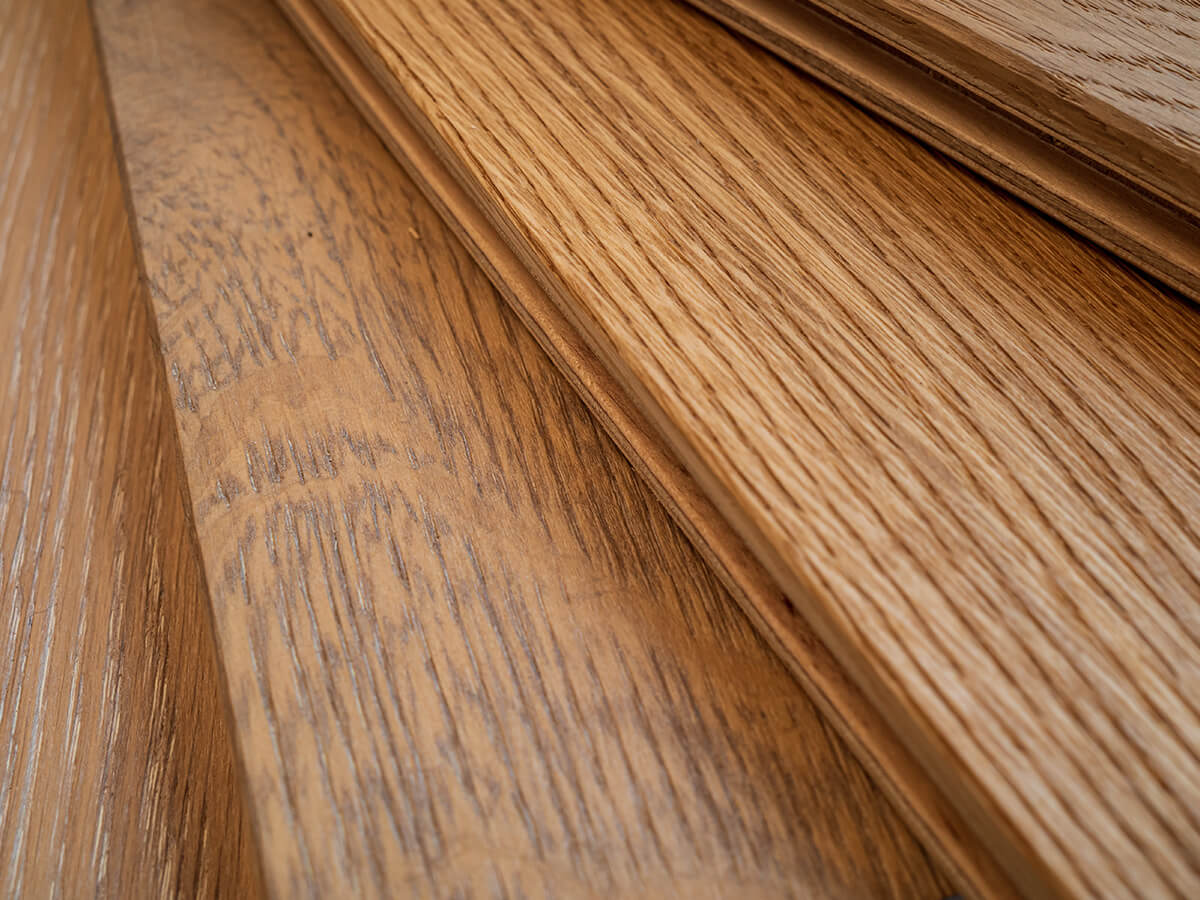
The core is the engine room of the plank. Its primary function is to provide structural integrity and, more importantly, to restrain the hardwood veneer. Wood is a hygroscopic material; it naturally wants to absorb moisture and expand, or release moisture and shrink.
In a climate as volatile as ours, where humidity swings from 90% in humid summers to 15% in dry winters, the core acts as a straightjacket. It forces the top layer to remain flat and stable when it desperately wants to twist, cup, or bow.
If the core fails, the floor fails. A weak core allows the locking mechanism to snap, the joints to separate, and the planks to delaminate. When we evaluate high-performance engineered flooring, we are essentially asking: which material creates a more stable, inert platform? To answer that, we have to look at how HDF and plywood react to stress differently.
Is Plywood the “Premium” Standard for a Reason?
Plywood is the traditional favourite for wood flooring in Toronto, using cross-laminated layers to ensure stability. However, quality varies significantly. While premium Baltic Birch is robust, cheaper options often contain hidden voids. If a heavy object strikes a void, the unsupported veneer dents or punctures easily, compromising the floor’s durability.
Is HDF Just “Glorified Cardboard” or Superior Engineering?
There is a massive misconception that HDF (High-Density Fiberboard) is the same as the particle board used in cheap furniture. This is false. HDF is a highly engineered composite made by compressing wood fibres with resin under extreme pressure and heat.
The key word is “density.” A high-quality HDF core is significantly harder and heavier than plywood.
- Uniformity: Unlike plywood, which can have knots or voids in the inner layers, HDF is perfectly uniform. There are no weak spots. This provides a consistent, anvil-like base for the wood veneer.
- Dent Resistance: Because the core is so dense, it resists impact much better than plywood. If you drop a can of soup on an HDF-core floor, the energy is absorbed by the density of the core, often preventing a dent in the wood surface. On a softer plywood core, the wood veneer might crush into the softer substrate.
- The Click-Lock Advantage: This is where HDF wins comfortably. Since the material is uniform and dense, the locking mechanism milled into the edge is incredibly strong. It can be machined to precise tolerances that plywood cannot match. Plywood layers can fray or chip when machined into delicate click systems, leading to weaker joints that may creak or separate over time.
How Do They Handle the Canadian Climate?
This is the deciding factor for most readers. Which one handles the dreaded “dry winter” better?
Plywood has a slight advantage in moisture resistance. If you have a flood or a major leak, plywood will swell, but it often retains its structural integrity better than HDF, which can swell and crumble if saturated for long periods. Plywood is more forgiving of high-moisture environments.
However, HDF is often superior in dry environments. Since it creates such a strong, rigid bond, HDF-core floors are less likely to develop the seasonal gapping that plagues wide-plank floors in winter. The density of the material holds the shape firmly. The risk with HDF is that if humidity is not controlled and drops too low, the core is so rigid that it won’t move with the veneer, potentially causing the veneer to check (crack).
Plywood allows for a tiny bit more flexibility, which can sometimes save the veneer from cracking under extreme stress.
Which Option is More Sustainable?
As we become more conscious of our renovation footprint, the environmental impact of these materials comes into focus. Plywood requires peeling unmatched logs, which can be resource-intensive. HDF, conversely, can often be made from post-industrial wood byproducts (sawdust and chips), making it a way to maximize the yield of a tree.
The data supports a deeper look into production methods. According to a study, the carbon footprint of wood flooring varies among different types, with raw material production and electricity consumption being major sources, and alternative electricity sources offering potential for emissions reduction (Lao et al., 2024).
This suggests that choosing an HDF floor manufactured in a facility using renewable energy might actually have a lower carbon profile than a plywood floor shipped from halfway across the world, regardless of the “natural” look of the plywood layers.
What About the “Creak” Factor?
One of the most annoying problems with aging floors is noise. Creaking happens when two surfaces rub against each other; usually the tongue and groove of the planks.
Plywood cores, because they are made of natural wood layers, can dry out over time. As the layers lose moisture, the plank can shrink slightly, causing movement in the joints. This movement generates noise.
HDF cores are bonded with resins that make them hydrophobic (water-repelling) and dimensionally inert. They do not dry out in the same way natural timber does. Consequently, HDF engineered floors tend to remain quieter over the long term. The precision of the milled HDF joints also means there is less “play” between planks, reducing the friction that causes squeaking.
So, Which Performs Better Long Term?
The answer depends on your specific risks.
If you are installing in an area with potential moisture issues (like a cottage that isn’t climate-controlled year-round, or a kitchen with a high risk of dishwasher leaks) high-quality Baltic Birch plywood is likely the safer long-term bet. Its ability to recover from moisture exposure is superior.
However, for the vast majority of residential homes with standard HVAC systems, HDF core is objectively the higher-performance option. It offers better impact resistance (protecting your expensive veneer from dents), stronger locking mechanisms (preventing gaps), and a quieter, more solid feel underfoot. It is a modern material engineered for modern living, whereas plywood is a legacy material that relies on variable natural qualities.
Secure the Right Core for Your Home
Choosing between HDF and plywood isn’t about “good vs. bad”; it’s about matching engineering to your lifestyle. The core determines whether your floor remains beautiful or becomes a burden. For expert advice and the finest engineered flooring in Toronto, contact Capital Hardwood Flooring. Call us today at (416) 536-2200 to ensure your investment is built to last.